



Leadership transitions often fail at the edges. While you can document an API schema or a server configuration in Confluence, you cannot easily zip up twenty years of relational trust with a critical vendor or key executive customer and attach it to a ticket.
Back in Week 3, we focused on mapping and building social capital internally, where the objective is creating reciprocity, knowledge exchange, and cultural safety (Week 3: Social Capital). However, a department does not operate in a vacuum. We now must focus on the second layer of influence: the external ecosystem.
Sociologist Pierre Bourdieu defined social capital as the aggregate of actual or potential resources linked to the possession of a durable network of institutionalized relationships. In technology leadership, social capital is commercial currency. Vendors know your personal cell number; account executives know how you negotiate; customers know you will answer the phone at midnight during a Sev-1 outage.
If a mentor exits without intentionally migrating this capital, the successor inherits an immediate trust deficit. The external ecosystem naturally attempts to route around the new leader, hunting for old backchannels.
"Trust is the glue of life. It’s the most essential ingredient in effective communication. It’s the foundational principle that holds all relationships." — Stephen R. Covey
In Week 8, we move the mentee’s focus from internal operational mechanics to the external ecosystem. We are shifting relationship authority from the person to the role.
Part 1: Technical Partnerships vs. Social Obligations
The critical distinction between internal and external social capital lies in its nature: internal capital is grounded in psychology, while external capital is grounded in economics. The risk isn’t that the team won’t trust the mentee, but that vendors and customers won’t trust the mentee to manage the commercial contract.
The first step in migrating external power is categorizing the department's vendor and partner landscape. The mentor and mentee must sit down and categorize every major external relationship into two distinct buckets:
- Technical Partnerships: These are relationships governed by service level agreements (SLAs), delivery milestones, uptime metrics, and contractual performance. Because they are grounded in objective data, they are straightforward to transition. The mentee earns credibility quickly by demonstrating a command of the metrics and project roadmaps.
- Social Obligations: These are the handshake deals and the oft-discussed plans for the future relationship that have not yet been formalized. These are the vendors retained because the mentor has known the VP of Sales for fifteen years, or the legacy consultant kept on retainer because of a critical favor done during a data center migration a decade ago.
The strategic goal of Week 8 is to deprecate social obligations and convert them back into technical partnerships.
If an account’s survival relies exclusively on the mentor’s personal history, it is not an asset—it is an organizational single point of failure. By auditing these dependencies together, the mentee is freed from maintaining the mentor's personal loyalties and empowered to evaluate vendors based on current performance and future architecture.
Part 2: The Action — The Read-Only Handoff
Email introductions like "Meet my successor, they'll be taking over soon" are passive, ineffective, and invite vendors to ignore the mentee until the mentor walks out the door.
This week, the mentor schedules formal Relationship Migration Sessions with the top three external vendors and key cross-functional stakeholders.
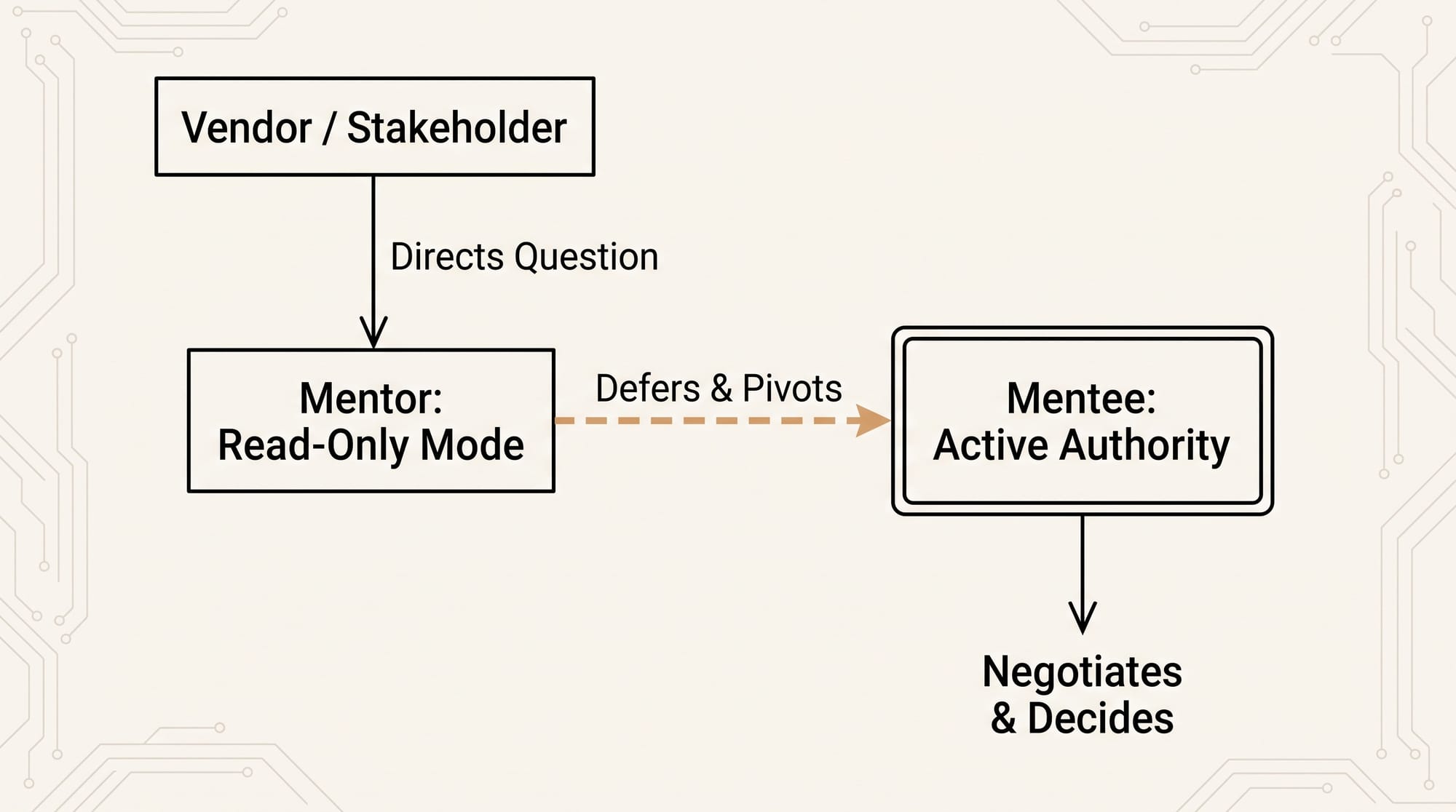
The Protocol for the Call:
- The Framing: The mentor opens the meeting with an explicit declaration of authority: "Going forward, [Mentee] owns our operational roadmap, vendor evaluations, and contract renewals for this portfolio."
- The Read-Only Pivot: During the conversation, vendors will instinctively direct technical and commercial questions to the mentor. The mentor must actively refuse the bait. Use the pivot script, "I have historical context on that, but [Mentee] is setting our strategic direction here. I’d like to hear their take first."
- The Bias Check & Body Language: For women and leaders from underrepresented backgrounds, external vendors frequently attempt to bypass the successor, seeking validation from the veteran leader. The mentor's physical and verbal deference in the room is the Reputational Shield that establishes the mentee's immediate authority.
- The Surgical Debrief: Spend 15 minutes immediately after the call evaluating the dynamic:
- Did the vendor attempt to route around the mentee?
- Did the mentee establish boundaries, or did they fall back into a passive note-taking role?
- What commercial levers does the mentee need to pull in the next interaction to solidify control?
Part 3: The Wilder-IT Edge — Purging "Relationship Debt"
Just as systems accumulate technical debt, departments accumulate Relationship Debt. Relationship debt consists of bloated SaaS contracts, underperforming legacy consultants, and overpriced vendors tolerated simply because the mentor didn't want the awkwardness of firing an old acquaintance.
As an outgoing leader, you possess the legacy immunity to speak hard truths without career fallout. Week 8 is the moment to be completely transparent with your successor:
"We have used this vendor for six years because their original team built our core framework. But their current support is a bottleneck, their account management has deteriorated, and their pricing is 20% above market. I want you to start planning a competitive RFP."
Handing over the keys doesn't mean forcing the mentee to carry your sacred cows. By explicitly naming relationship debt, the mentor gives the mentee permission to renegotiate, restructure, or replace inefficient partnerships on day one without feeling disloyal to the past.
Facilitator's Checklist for Week 8
- The External Audit: Categorize the top 5 vendor relationships into Technical Partnerships vs. Social Obligations.
- The Handoff Sessions: Conduct at least two live vendor or customer meetings where the mentor remains in strictly "Read-Only" mode.
- The Deferral Test: Ensure the mentor successfully redirected at least one direct commercial or operational inquiry to the mentee during a live session.
- Debt Identification: Identify and document at least one legacy vendor or contract that qualifies as Relationship Debt for the mentee to review or renegotiate.
- The Social Migration Log: Update the Readiness Dossier to reflect that primary vendor communications and decision rights have shifted to the mentee.
References
- Bourdieu, Pierre (1986). "The Forms of Capital." In J. Richardson (Ed.), Handbook of Theory and Research for the Sociology of Education. New York: Greenwood Press.
- Covey, Stephen R. (2006). The Speed of Trust: The One Thing That Changes Everything. New York: Free Press. ISBN 978-0743297301.
- Lencioni, Patrick (2002). The Five Dysfunctions of a Team: A Leadership Fable. San Francisco: Jossey-Bass. ISBN 978-0787960759.
Member discussion